7. BILGE PUMPS & FLOAT SWITCHES
Verify their operation. Often! sure you hear the pump running. Better yet, install the drain plug, raise your bow up, and fill bilge with water. Manually test the bilge pump with the dash switch and be sure it pumps water. Verify that float switch cuts on as the water level rises, if it does not have it checked or replaced. Tech Notes: We have heard pumps run but not pump due to a spun impeller. The time to find out you bilge pump is inoperable is not when you need it the most.
We recommend that offshore fisherman carry a spare manual bilge pump and an electric pump with 10’ – 15’ of hose that is equipped with extra length wiring terminated to alligator clips. In an emergency, put the emergency pump in the bilge, hook up the clips to the battery and extend the hose over the side. A Jump Start box is also a great emergency piece of equipment to have offshore and it can power that emergency bilge pump.
8. NAVIGATION LIGHTS
You cannot believe how much we see the following scenario. A boat owner for years has used his boat only in the daytime hours and then the first time he needs his navigation lights they don’t work. They probably have not worked for years. Verify your navigation light operation every time you go out. You never know when your excursion may have you coming back after the sun sets. Running at night without lights is dangerous and illegal. Keep spare bulbs on board along with fuses. Common light failure problems revolve around switches, bulbs, corroded sockets and bad wiring connections.
9. PROP SHAFT
It is a good idea to remove your prop at the beginning of each season and grease the prop shaft and reinstall it. When you have the prop off remove the forward thrust washer and check for any fishing line that may have been caught in the prop. Monofilament fishing line and especially the new braided lines are quite adept at cutting into your seal and allowing water into your lower unit gearcase. If you fish a lot, especially bottom fish I would check a lot more often. Before each trip instruct your fishing crew that you need to know any time they get their line caught in the props. Their honesty and quick disclosure can save you a lot of expense and aggravation in the future. Techs Notes: Carry extra cotter pins with you if you need to make an emergency prop removal to remove fishing line. Better yet carry a full set of prop hardware in case something goes overboard. Please do not drop the prop!
10. GEARCASE LUBE
Gearcase lube should be changed every 100 hours or once a year whichever comes first. This is an easy do it yourself job and we have the items and advice you need to do this and save some money. Be sure to change out the gearcase washers every time you change your lube. Check regularly for water intrusion. Gearcase oil should be honey colored when fairly new and darken with age. Lube that is cream colored or rusty colored is contaminated with water. A silver color usually means internal metal damage. Both of these are a major cause for concern and should be immediately evaluated to determine the cause of the problem. Techs Notes: A quick way to check your gearcase level and its lubricity characteristic is to remove the top plug only and insert an extra long pipe cleaner down into the gearcase to pull a lube sample. Wrap one end on your finger so do not drop it.
11.TRAILER BRAKES
We think that there are probably more boat trailers plying the roadways with brakes that are inoperable than those that are operable. This is a dangerous situation and you know what we mean if you have ever been pushed through a stoplight by a boat and trailer. The brakes on your tow vehicle are not built to stop larger boats. In Alabama trailer brakes are required on at least one axle for trailers with more than a 3000# rating. Many trailer owners have no clue as to whether their brakes are working or not. Many do not even know how to check the brake fluid level. Submerging brake components in saltwater on a regular basis creates a situation that demands more intense maintenance and more frequent operation.
Things have become somewhat easier over the past few years as most manufacturers are switching over to disc brake packages with non corrosive components. It is still not a perfect world though and you must check your brakes regularly. Start at the brake surge coupler at the front of the trailer and check the fluid level. The proper fluid is DOT-3 and the correct level is 3/8” below the top of the reservoir. If your check reveals a total lack of brake fluid you need to act immediately as the inside of the brake coupler will rust in the absence of brake fluid. If your inspection reveals no fluid and a rusty residue inside, your coupler has probably died an unnatural death and will need replacing. Fluid loss usually stems from leaks at the brake lines, connections, or the brake cylinders themselves. Actuator travel should also be verified. Your actuator operates like piston, when the tow vehicle slows the actuator moves forward and applies pressure to the brake fluid which causes the brakes to engage. If fluid is contaminated the entire brake system should be drained, flushed and bled.
Drum brakes - They should be checked on a yearly basis with the outer drum/hub removed and internal components checked for corrosion and parts degradation. It is also recommended that the brakes be adjusted every year. Corroded components should also be replaced. Tech Notes: Rather than spend a lot of money repairing drum brakes we feel your money would be better spent converting to disc brakes. They are lower maintenance and require no annual adjustment.
Disc Brakes - Check pads, rotors and master cylinder. Look for uneven wearing, scoring, cracking, warping or corrosion. Replace pads if less than 1/8” thick, new pads start out at 3/8” of thickness. Check reversing solenoid operation. The reversing solenoid is activated by your tow vehicles reverse light circuit and frees the brakes for reverse operation. Warped rotors are usually caused by improper backing with the reverse solenoid not properly engaged.
Tech Notes: To prolong the life of your brakes…after you back up your trailer to park ease forward about 2”. This will pull the actuator forward relieving the pressure on the brake components.
12. WHEEL BEARINGS
The number one cause of trailer breakdowns, especially in a saltwater environment. Bearings should be greased on a regular basis but repacked on an annual basis. Most of today’s trailers utilize two different types of bearing covers that allow for regular greasing, the posi-lube system or the Bearing Buddy system. Both systems allow grease to be added easily but are not to be mistaken as a replacement for an annual bearing repacking.
When repacking bearings, the wheels are removed, hub dis-assembled bearings, races and spindles inspected and cleaned. Seals are replaced as well as any corroded or pitted bearings and races at this time. You should always shake test your tires before each trip to see if you notice any sloppiness that may be the sign of early bearing failure. For the Do It Yourselfer, we keep a full line of trailer parts in our parts department.
We often get trailers in that have the lug nuts so rusty that they cannot be removed or the corrosion has altered their shape so that no wrench can remove them. What would this guy do on the side of a dark road at night? At this point they must be cut or burnt off, a rather expensive proposition. Techs Notes: We recommend that lug nuts be removed annually, greased and reinstalled with proper torque values.
Safe boating!
Saturday, February 4, 2012

Friday, February 3, 2012
The Rasch Outdoor Chronicles: The Range Reviews: Sterling Knife Sharpeners
Readers,
It seems that the Raschman has resurrected! I am looking forward to hearing his tales and outdoor adventures!
He has done a nice review here: The Rasch Outdoor Chronicles: The Range Reviews: Sterling Knife Sharpeners
Cheers!
Mike S
It seems that the Raschman has resurrected! I am looking forward to hearing his tales and outdoor adventures!
He has done a nice review here: The Rasch Outdoor Chronicles: The Range Reviews: Sterling Knife Sharpeners
Cheers!
Mike S
Friday, January 27, 2012
Boat Maintenance PT I
A Dirty Dozen for your Fishing Boat PT I
I have seen plenty of service and maintenance items that most of us might think aren’t really all that important.
We would, of course, be wrong. I have assembled a series of things that can sometimes be taken for granted and overlooked for annual service. We’re not talking about dings in the gel coat, torn upholstery, broken livewell pumps and stuff like that, we’re talking about things that have a tremendous potential impact on your safety, reliability, fuel-economy and trouble-free operation.
Let's call it the “Dirty Dozen” – and today, let me share a half-dozen with you.
Out of Sight, Out of Mind
1. FUEL WATER / SEPARATOR FILTERS
If you do not have one, get one, NOW! Many boaters do not even know if they have one on their boat or not. Many dealers commit a monumental travesty to their customer by not recommending or installing them on delivered boats. Clean fuel is the lifeline of today’s technologically advanced outboard engines. Contaminated fuel is the number-one single service problem that we find in our shop. The sensors monitoring the fuel delivery system on your fuel-injected outboard go haywire when water gets introduced into the mix.
Many boat owners seem to have the belief that if a fuel/water separator filter is mounted on the boat that they are good to go and protected forever. Not true! These filters need to be serviced and inspected on a regular basis. They do filter water out of your fuel but they also capture it while doing so. Once that capture capacity is reached any additional separated water goes directly into your engine. At that point you no longer have any protection from water entering your fuel system.
We recommend that you replace these filter elements yearly or sooner, especially if the exterior of the element is rusty. It is an easy do It yourself Job. During the boating season, we recommend that the filter be inspected monthly, removed and the contents dumped into a quart Zip Loc freezer bag so that you can get a visual snapshot of your fuel condition. Turn the bag 45 degrees to form a corner. Any water will now be readily visible; you will see a clear line of separation between the two liquids as they separate due to their different viscosity. If there is no water or contaminants present, put the contents of the bag back into the filter element and screw it back on to the filter head assembly.
Just like an oil filter, a little oil should be applied on the rubber seal prior to re-installation. If the fuel sample is contaminated, dispose of the bad fuel and put fresh fuel into the filter before it is re-installed. When working on a fuel filter we recommend that you pre-run your engine prior to performing any work. By doing so you will be assured that your fuel delivery system is fully charged. A fully charged fuel system will allow the engine to run long enough after the canister element is replaced for the vacuum of the fuel pump to refill the canister element. Tech Notes: Please exercise caution and good sense when working with gasoline and dispose of it properly.
If you have one of the new style “clear bowl” filter elements manufactured by Racor you do not have to remove the filter element to inspect for water. Any water that this filter separates is instantly visible in the clear inspection bowl on the bottom of the filter. It has a handy twist drain on the bottom which allows for the water to be removed into a small jar or zip loc bag. These units cost a little more, but are well worth the cost as they are the “state of the art” in fuel filtration. They can be purchased as a kit that will retro fit most standard fuel filter head assemblies. This is money well spent because the consequences of not having a good quality filter are far outweighed by the benefits.
2. FLARES AND FIRE EXTINGUISHERS
Flares – Be sure to check the expiration date, they only have about a 3 year service life. Even though your outdated flares may be in good working condition you will still get a citation from the Marine Patrol if they are expired. Replace with new ones but save the old ones in your emergency supplies kit. We hope you never need them but they have saved many lives. If you venture offshore be sure to get both handheld flares and aerial flares.
Fire Extinguisher – Check to be sure it is fully charged. If it is not it will not pass Marine Patrol inspection and you will get a ticket. Buy a new one before that happens because the ticket is a heck of a lot higher than the $15 to $20 you will spend at our ship’s store. If you are ever in the situation where you have to discharge one, you would pay many times that amount. It’s prompt use in an emergency situation can save you and your boat.
3. WATER PUMPS & THERMOSTATS
Water Pumps – Should be changed out at least every 2 years minimum. Yamaha now recommends changing them yearly and our recommendation is to do so if a lot of your boating involves running your engine in sand and muck. Impellers also develop a “set” over time and will not pump as much volume to the engine. A failed water pump is the #1 reason for a total stranding as documented by our service department.
Thermostats – Should be changed when you change out the water pump impeller. Today’s outboard engines are finely tuned machines and the temperature they operate at is critical for proper performance and reliability. In fact, some of Honda’s newer engines run at 3 different temperatures as part of their design. Marine thermostats are similar to what you find in automobiles with one exception; around here they run in saltwater and suffer the consequences of early deterioration and failure. This means they must be changed much more than those in your automobile.
4. ENGINE MOUNTED INTERNAL FUEL FILTERS
The fact that today’s fuel injected outboards depend so much on a clean fuel supply for their proper operation is an issue not taken lightly by the engine manufacturers. Most manufactures provide additional protection to their engines within the design of their fuel delivery system. Most of these filters are not readily changeable and are buried deep in the bowels of the fuel system. There can be filters on both the low and high pressure sides and they can require some disassembly to access. A savvy do it yourselfer can perform most of these tasks but if you do not trust your skills take it to the dealer. We stock most of these filters and we will be glad to provide you with a parts breakdown to assist you in your efforts. Check your maintenance manual for the schedule for changing out these filters on your boat. If you run offshore a lot you should spend special attention to the maintenance of these filters, their failure can leave you stranded a long way from home.
We often find that these filters can become a cause of failure when engines start to get increased operating hours on them. Age in the field also has a lot to do with it. Typical failure is a collapse of the element as the filter media becomes so clogged that it can no longer pass fuel. They can fail prematurely if the onboard fuel/water separator filter system on the boat is neglected or non-existent. The engine mounted filters then do a job they were not designed for and this can lead to premature and often catastrophic failure. This is another reason that you MUST HAVE a good quality fuel/water separator system on your boat and it should be properly maintained. Are we sounding like a broken record here? Good!
5. HYDRAULIC STEERING
Please pay special attention here as we consider this a safety issue. Have your hydraulic steering system bled and inspected yearly. Air is man’s best friend but a hydraulic steering system’s worst enemy. Air in a hydraulic steering system diminishes performance, response and can lead to a total loss of steering. Today’s hydraulic systems are very complex with a myriad of hoses connecting autopilot pumps, power steering pumps and even liquid tie bars. All of these create extra connections where leaks can occur that can lead to decreased steering performance.
Also pay attention to your steering cylinders that are mounted on your engines. Occasionally inspect the outer seals where the chrome steering bar exits the cylinder. If you notice fluid here you have a problem that must be addressed immediately. After a day on the water, be sure to clean these chrome rods with soapy water to remove any salt residue that might lead to pitting and premature failure of the seals. Make it part of your regular boat cleanup routine. You will want to carefully inspect the back of your steering helm for leaks, as well as all of the connector fittings.
A properly bled steering system is a tight steering system, when you push on your motor it should barely move, if it moves more than a little you are probably a candidate for a steering re-bleed. You can bleed your steering system yourself but we recommend that you bring it to a dealer who has a Power Purger which is a machine that pumps fluid into the system and removes air at the same time. A single station rig can be bled in less than half an hour. The addition of power steering pumps and autopilots on some boats require a more complex bleeding sequence and for these setups we only recommend the Power Purger system.
6. BATTERIES
Water, water everywhere! Except in your batteries. What’s with that? The water level in your batteries must be checked on a regular basis. Check them even more often if you have them hooked up to any kind of automatic charging system. Regardless of what the charging system manufacturer advertises, check your water! Improper electrolyte levels are the #1 cause of early battery failure.
Battery connections on most marine batteries are usually made with the wing nuts. The problem with wing nuts is that most people think they are sufficiently tight when they cannot tighten them any further. That is when you get the pliers and tighten them yet again. If you can remove your battery wing nuts with your fingers, they are too loose. Plier Tight Please! You cannot believe how many boaters come in here thinking they need a starter when all we had to do was tighten the battery connections. Tech’s Note: If you remove your batteries be sure to bundle the wires together with a twist tie to be sure they go back on the same way and that polarity is verified before reattachment.
In our next Post: The Dirty Dozen, Part II.
I have seen plenty of service and maintenance items that most of us might think aren’t really all that important.
We would, of course, be wrong. I have assembled a series of things that can sometimes be taken for granted and overlooked for annual service. We’re not talking about dings in the gel coat, torn upholstery, broken livewell pumps and stuff like that, we’re talking about things that have a tremendous potential impact on your safety, reliability, fuel-economy and trouble-free operation.
Let's call it the “Dirty Dozen” – and today, let me share a half-dozen with you.
Out of Sight, Out of Mind
1. FUEL WATER / SEPARATOR FILTERS
If you do not have one, get one, NOW! Many boaters do not even know if they have one on their boat or not. Many dealers commit a monumental travesty to their customer by not recommending or installing them on delivered boats. Clean fuel is the lifeline of today’s technologically advanced outboard engines. Contaminated fuel is the number-one single service problem that we find in our shop. The sensors monitoring the fuel delivery system on your fuel-injected outboard go haywire when water gets introduced into the mix.
Many boat owners seem to have the belief that if a fuel/water separator filter is mounted on the boat that they are good to go and protected forever. Not true! These filters need to be serviced and inspected on a regular basis. They do filter water out of your fuel but they also capture it while doing so. Once that capture capacity is reached any additional separated water goes directly into your engine. At that point you no longer have any protection from water entering your fuel system.
We recommend that you replace these filter elements yearly or sooner, especially if the exterior of the element is rusty. It is an easy do It yourself Job. During the boating season, we recommend that the filter be inspected monthly, removed and the contents dumped into a quart Zip Loc freezer bag so that you can get a visual snapshot of your fuel condition. Turn the bag 45 degrees to form a corner. Any water will now be readily visible; you will see a clear line of separation between the two liquids as they separate due to their different viscosity. If there is no water or contaminants present, put the contents of the bag back into the filter element and screw it back on to the filter head assembly.
Just like an oil filter, a little oil should be applied on the rubber seal prior to re-installation. If the fuel sample is contaminated, dispose of the bad fuel and put fresh fuel into the filter before it is re-installed. When working on a fuel filter we recommend that you pre-run your engine prior to performing any work. By doing so you will be assured that your fuel delivery system is fully charged. A fully charged fuel system will allow the engine to run long enough after the canister element is replaced for the vacuum of the fuel pump to refill the canister element. Tech Notes: Please exercise caution and good sense when working with gasoline and dispose of it properly.
If you have one of the new style “clear bowl” filter elements manufactured by Racor you do not have to remove the filter element to inspect for water. Any water that this filter separates is instantly visible in the clear inspection bowl on the bottom of the filter. It has a handy twist drain on the bottom which allows for the water to be removed into a small jar or zip loc bag. These units cost a little more, but are well worth the cost as they are the “state of the art” in fuel filtration. They can be purchased as a kit that will retro fit most standard fuel filter head assemblies. This is money well spent because the consequences of not having a good quality filter are far outweighed by the benefits.
2. FLARES AND FIRE EXTINGUISHERS
Flares – Be sure to check the expiration date, they only have about a 3 year service life. Even though your outdated flares may be in good working condition you will still get a citation from the Marine Patrol if they are expired. Replace with new ones but save the old ones in your emergency supplies kit. We hope you never need them but they have saved many lives. If you venture offshore be sure to get both handheld flares and aerial flares.
Fire Extinguisher – Check to be sure it is fully charged. If it is not it will not pass Marine Patrol inspection and you will get a ticket. Buy a new one before that happens because the ticket is a heck of a lot higher than the $15 to $20 you will spend at our ship’s store. If you are ever in the situation where you have to discharge one, you would pay many times that amount. It’s prompt use in an emergency situation can save you and your boat.
3. WATER PUMPS & THERMOSTATS
Water Pumps – Should be changed out at least every 2 years minimum. Yamaha now recommends changing them yearly and our recommendation is to do so if a lot of your boating involves running your engine in sand and muck. Impellers also develop a “set” over time and will not pump as much volume to the engine. A failed water pump is the #1 reason for a total stranding as documented by our service department.
Thermostats – Should be changed when you change out the water pump impeller. Today’s outboard engines are finely tuned machines and the temperature they operate at is critical for proper performance and reliability. In fact, some of Honda’s newer engines run at 3 different temperatures as part of their design. Marine thermostats are similar to what you find in automobiles with one exception; around here they run in saltwater and suffer the consequences of early deterioration and failure. This means they must be changed much more than those in your automobile.
4. ENGINE MOUNTED INTERNAL FUEL FILTERS
The fact that today’s fuel injected outboards depend so much on a clean fuel supply for their proper operation is an issue not taken lightly by the engine manufacturers. Most manufactures provide additional protection to their engines within the design of their fuel delivery system. Most of these filters are not readily changeable and are buried deep in the bowels of the fuel system. There can be filters on both the low and high pressure sides and they can require some disassembly to access. A savvy do it yourselfer can perform most of these tasks but if you do not trust your skills take it to the dealer. We stock most of these filters and we will be glad to provide you with a parts breakdown to assist you in your efforts. Check your maintenance manual for the schedule for changing out these filters on your boat. If you run offshore a lot you should spend special attention to the maintenance of these filters, their failure can leave you stranded a long way from home.
We often find that these filters can become a cause of failure when engines start to get increased operating hours on them. Age in the field also has a lot to do with it. Typical failure is a collapse of the element as the filter media becomes so clogged that it can no longer pass fuel. They can fail prematurely if the onboard fuel/water separator filter system on the boat is neglected or non-existent. The engine mounted filters then do a job they were not designed for and this can lead to premature and often catastrophic failure. This is another reason that you MUST HAVE a good quality fuel/water separator system on your boat and it should be properly maintained. Are we sounding like a broken record here? Good!
5. HYDRAULIC STEERING
Please pay special attention here as we consider this a safety issue. Have your hydraulic steering system bled and inspected yearly. Air is man’s best friend but a hydraulic steering system’s worst enemy. Air in a hydraulic steering system diminishes performance, response and can lead to a total loss of steering. Today’s hydraulic systems are very complex with a myriad of hoses connecting autopilot pumps, power steering pumps and even liquid tie bars. All of these create extra connections where leaks can occur that can lead to decreased steering performance.
Also pay attention to your steering cylinders that are mounted on your engines. Occasionally inspect the outer seals where the chrome steering bar exits the cylinder. If you notice fluid here you have a problem that must be addressed immediately. After a day on the water, be sure to clean these chrome rods with soapy water to remove any salt residue that might lead to pitting and premature failure of the seals. Make it part of your regular boat cleanup routine. You will want to carefully inspect the back of your steering helm for leaks, as well as all of the connector fittings.
A properly bled steering system is a tight steering system, when you push on your motor it should barely move, if it moves more than a little you are probably a candidate for a steering re-bleed. You can bleed your steering system yourself but we recommend that you bring it to a dealer who has a Power Purger which is a machine that pumps fluid into the system and removes air at the same time. A single station rig can be bled in less than half an hour. The addition of power steering pumps and autopilots on some boats require a more complex bleeding sequence and for these setups we only recommend the Power Purger system.
6. BATTERIES
Water, water everywhere! Except in your batteries. What’s with that? The water level in your batteries must be checked on a regular basis. Check them even more often if you have them hooked up to any kind of automatic charging system. Regardless of what the charging system manufacturer advertises, check your water! Improper electrolyte levels are the #1 cause of early battery failure.
Battery connections on most marine batteries are usually made with the wing nuts. The problem with wing nuts is that most people think they are sufficiently tight when they cannot tighten them any further. That is when you get the pliers and tighten them yet again. If you can remove your battery wing nuts with your fingers, they are too loose. Plier Tight Please! You cannot believe how many boaters come in here thinking they need a starter when all we had to do was tighten the battery connections. Tech’s Note: If you remove your batteries be sure to bundle the wires together with a twist tie to be sure they go back on the same way and that polarity is verified before reattachment.
In our next Post: The Dirty Dozen, Part II.
Wednesday, June 8, 2011
Blake Rasch's Strikes, Bites, and Fights!: Using Spinnerbaits During Bedding Season
Blake Rasch's Strikes, Bites, and Fights!
Here is a fine young man starting on his way to becomeing a fishing guide:
Blake Rasch's Strikes, Bites, and Fights!: Using Spinnerbaits During Bedding Season
The bream start bedding pretty early here in West Central Florida, and when I see them start to make their beds, I take out my spinnerbaits and start working the areas just outside the beds. You know that the bass are hungry, and are looking for a meal in the shallows where the panfish are bedding."
I like his style, and he seems well on his way to a professional career! Stop by and say hello!
Cheers,
Mike Spin
Here is a fine young man starting on his way to becomeing a fishing guide:
Blake Rasch's Strikes, Bites, and Fights!: Using Spinnerbaits During Bedding Season
"Using Fish Creek Spinners for Largemouth Bass
During Bluegill Spawn
During Bluegill Spawn
The bream start bedding pretty early here in West Central Florida, and when I see them start to make their beds, I take out my spinnerbaits and start working the areas just outside the beds. You know that the bass are hungry, and are looking for a meal in the shallows where the panfish are bedding."
I like his style, and he seems well on his way to a professional career! Stop by and say hello!
Cheers,
Mike Spin
Sunday, February 6, 2011
Jerky Making Tips and Techniques
Making Deer Jerky: Some Tips
 Frankfort, Kentucky - Every year I look forward to making deer jerky. The scent of spicy marinade fills my kitchen as I thaw, cut, soak and dry, gradually emptying my freezer full of deer meat. I beam like a kid on Christmas morning when I lift the top of the dehydrator, revealing tray after tray of perfectly dried strips of venison. I pack the cooled jerky into plastic bags with various marinade labels, and can't wait to give them to friends, family and co-workers.
If I seem over-enthusiastic about making jerky, it's probably because I can't cook. My attempts have led to small kitchen fires, burnt breakfast pastries and even my Mom's classic dinner-table comment, "Well, at least we have a good dessert."
My point is, if I can make jerky, anyone can. Entire books are written on this subject, and there are many ways to do it well. But there are a few things I wish I'd known when I started. Through trial and error I've learned to use a lot of meat, clean it well, cut it consistently, marinade it for just a few hours, and dry it longer than it seems to need.
It takes a lot of deer meat to make a small amount of jerky. Ever heard the saying that our bodies are mostly water? The same is true of deer. Ten pounds of venison becomes about two pounds of jerky after drying. So set aside plenty of meat if you plan to share. It's amazing how quickly your jerky will disappear. People love this stuff.
The cleaner your meat, the better your jerky will taste. Remove the whitish membrane, or 'silver seam', from the outside of the meat, as well as all the gristle and sinew that you can cut off. If you don't plan to make jerky right away, wrap the meat tightly in butcher paper and freeze it, then move it to the refrigerator a couple of days before you're ready to begin. Meat that is still partially frozen is far easier to cut than completely thawed meat.
 I use only the large muscle groups like hams and shoulders for jerky. Large sections of meat are easier to cut and dry more consistently than smaller, more irregularly shaped pieces. Save the small cuts for stew or hamburger meat, and the tenderloins for steaks.
Be consistent in your cutting, making all strips the same thickness. It's a pain to remove jerky from the oven or dehydrator in shifts, but that's exactly what you'll be doing if your meat isn't a uniform thickness.
If you like brittle jerky, cut across the grain. If you want chewier jerky, cut with the grain. Some people prefer to turn their venison into hamburger first, then use a jerky gun to make uniform strips. I prefer the texture of cut jerky, but either method can yield good results.
Soak the cut strips of meat in marinade for a few hours to overnight, depending on how strong you want the marinade flavor. Turn the meat several times while it soaks. Marinating too long can overwhelm the taste or lead to mushy, stringy meat.
An oven works just fine for jerky making, and many people prefer this method. I prefer a dehydrator. It takes a lot of the guess-work out of the process. I know exactly how long it will take to dry a quarter-inch thick piece of venison, and I know that every piece is drying at the same temperature. Besides, making jerky is messy, and I can throw my dehydrator racks in the dishwasher. I'd rather dress a deer than chisel dried, caked-on marinade out of my oven.
Dry the jerky a bit longer than it seems to need. The jerky's surface should crack when you bend it, but the piece should not break apart. Moisture will build up during storage, and pulling it too soon will result in sticky jerky within a day.
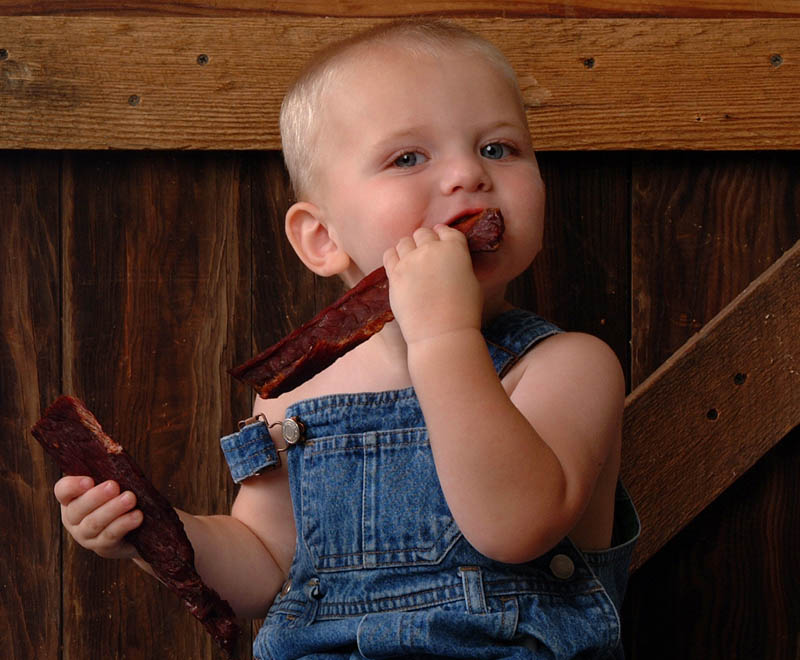 Mmmm! That's good!
For marinade recipes, storage tips and more, buy a good jerky-making book or search online. There's plenty of information out there to create this convenient, high-protein snack. Best of all, even the worst cook can make great deer jerky.
Author Hayley Lynch is an award-winning writer for Kentucky Afield magazine, the official publication of the Kentucky Department of Fish and Wildlife Resources. She is an avid hunter and shotgun shooter.
Related Posts:
The Rasch Outdoor Chronicles: How to Smoke Fish: Two Methods.
Friday, February 4, 2011
Catching Humboldt Squid
California Anglers Ask About Humboldt Squid
Editor's Note: The following comes to us from Carrie Wilson of California Department of Fish and Game. It seems Humboldt squid are making things interesting for California offshore anglers. Good numbers of Humboldt squid have been showing up off the California coast in recent years. Although there are no bag limits at this time, anglers should be conservation-minded and take only what they can comfortably use. One large jumbo squid can easily feed an entire family for quite a long time.
Question: There's been a huge population of Humboldt squid showing up off the central California coast in recent years. As aggressive as they are, I am curious what effects they may be having on our game fish populations. These squid are also really fun to catch and it's easy to get caught up in the frenzy of the fishing when you get into a big school of them. Unfortunately, the result is often boats and their anglers wind up harvesting more than they can handle, and many of these big squid end up going to waste. Should we have bag limits on them? (John P., San Jose)
Answer: Humboldt, or jumbo squid (Dosidicus gigas) have indeed made their return to California waters, and in a big way. They are now being caught on party boats from San Diego to Fort Bragg. Special evening trips that specifically target the squid are catching behemoths ranging from 12 to 40 lbs.
 As far as what impact the Humboldt squid may be having on other game fish populations, the jury is still out. The squid's major prey items include lantern fishes; however, lantern fishes are prey to a lot of other game fishes, so it may be more of a competition aspect rather than strictly a predator-prey aspect. Humboldt squid are more efficient predators in low oxygen environments than fish predators and can out-compete these species. However, they also feed on a wide range of species from northern anchovy, Pacific sardine, Pacific mackerel, juvenile rockfishes, and squid species (including themselves, hence their reputation) so there is great potential to directly affect game fish populations.
According to Senior Marine Biologist and DFG squid expert Dale Sweetnam, "Researchers have been observing the expansion and shallowing of oxygen minimum zones off the West Coast in recent years. It is that environment that Dosidicus flourishes in and is probably the reason that they are still out and about and in no hurry to leave."
As far as what impact the Humboldt squid may be having on other game fish populations, the jury is still out. The squid's major prey items include lantern fishes; however, lantern fishes are prey to a lot of other game fishes, so it may be more of a competition aspect rather than strictly a predator-prey aspect. Humboldt squid are more efficient predators in low oxygen environments than fish predators and can out-compete these species. However, they also feed on a wide range of species from northern anchovy, Pacific sardine, Pacific mackerel, juvenile rockfishes, and squid species (including themselves, hence their reputation) so there is great potential to directly affect game fish populations.
According to Senior Marine Biologist and DFG squid expert Dale Sweetnam, "Researchers have been observing the expansion and shallowing of oxygen minimum zones off the West Coast in recent years. It is that environment that Dosidicus flourishes in and is probably the reason that they are still out and about and in no hurry to leave."Although there is no limit at this time on the number of Humboldt squid that can be caught, anglers should be conservation-minded and take only what they can comfortably use. Landing reports indicate that large numbers of squid are not only being caught, but also being kept. The DFG is also receiving disturbing reports of a number of fishermen actually then dumping these dead squid when returning to the docks. Not only is this unethical but it also constitutes violations of wanton waste which is willfully wasting the state's fish resources (CCR Title 14 Section 1.87.)
For everyone who gets the fun opportunity to fish for these enormous mollusks, take only what you plan to use. One large jumbo squid can easily feed an entire family for quite a long time. By being thoughtful and helping to conserve the state's marine resources, we hope these animals will keep coming back in good numbers for years to come.
 Seared Humboldt Squid
If you catch a jumbo squid and do not plan on eating it, please release it back into the water. These monster-sized creatures are a lot of fun to catch and they will usually survive when released to be caught by another angler on another day.
Tuesday, January 25, 2011
Self Sufficiency with The Rasch Outdoor Chronicles
Friends,
Mr Rasch, intrepid host and editor of The Rasch Outdoor Chronicles™ has recently put together a series of articles on Self Sufficiency.
The Rasch Outdoor Chronicles: How to Smoke Fish: Two Methods.: Smoked fish are fish that have been cured by smoking. As part of our Self Sufficiency series, we have researched the process for smoking fish for our faithful and errudite readers. The preservation of fish has been an integral part of every culture that subsisted on fish.
The Rasch Outdoor Chronicles: Drying and Preserving Fruit: Drying has to be the simplest, most cost efficient, and most natural method of preserving food.Drying is a creative way to preserve foods and use home-grown fruit, extra produce (e.g., ripe bananas) and roadside market specials.
The Rasch Outdoor Chronicles: QDM: Fruit Bearing Trees for your Land: A well planted and designed orchard will not only provide an irresistable food source for deer, (And other game too!) but will definitly increase the value of your property! While it does take longer to get an orchard established, the long term cost is much reduced compared to other food plots. Maintainance is less, and the production can be quite long depending on the species of tree planted.
Cheers!
Mike S.
Mr Rasch, intrepid host and editor of The Rasch Outdoor Chronicles™ has recently put together a series of articles on Self Sufficiency.
The Rasch Outdoor Chronicles: How to Smoke Fish: Two Methods.: Smoked fish are fish that have been cured by smoking. As part of our Self Sufficiency series, we have researched the process for smoking fish for our faithful and errudite readers. The preservation of fish has been an integral part of every culture that subsisted on fish.
The Rasch Outdoor Chronicles: Drying and Preserving Fruit: Drying has to be the simplest, most cost efficient, and most natural method of preserving food.Drying is a creative way to preserve foods and use home-grown fruit, extra produce (e.g., ripe bananas) and roadside market specials.
The Rasch Outdoor Chronicles: QDM: Fruit Bearing Trees for your Land: A well planted and designed orchard will not only provide an irresistable food source for deer, (And other game too!) but will definitly increase the value of your property! While it does take longer to get an orchard established, the long term cost is much reduced compared to other food plots. Maintainance is less, and the production can be quite long depending on the species of tree planted.
Cheers!
Mike S.
Wednesday, December 22, 2010
The Coming Mini-Ice Age
I was thinking that it's been a might bit chilly lately.
Perhaps Al Gore is wrong?
There's a Mini Ice Age Coming, Says man who beats weather experts
Piers Corbyn not only predicted the current weather, but he believes things are going to get much worse, says Boris Johnson, London's mayor
The man who repeatedly beats the Met Office at its own game
Well, folks, it's tea-time on Sunday and for anyone involved in keeping people moving it has been a hell of a weekend. Thousands have had their journeys wrecked, tens of thousands have been delayed getting away for Christmas; and for those Londoners who feel aggrieved by the performance of any part of our transport services, I can only say that we are doing our level best.
Almost the entire Tube system was running on Sunday and we would have done even better if it had not been for a suicide on the Northern Line, and the temporary stoppage that these tragedies entail. Of London's 700 bus services, only 50 were on diversion, mainly in the hillier areas. On Saturday, we managed to keep the West End plentifully supplied with customers, and retailers reported excellent takings on what is one of the busiest shopping days of the year.
Advertisement: Story continues below We have kept the Transport for London road network open throughout all this. We have about 90,000 tons of grit in stock, and the gritters were out all night to deal with this morning's rush. And yet we have to face the reality of the position across the country.
It is no use my saying that London Underground and bus networks are performing relatively well - touch wood - when Heathrow, our major international airport, is still effectively closed two days after the last heavy snowfall; when substantial parts of our national rail network are still struggling; when there are abandoned cars to be seen on hard shoulders all over the country; and when yet more snow is expected today, especially in the north.
In a few brief hours, we are told, the snowy superfortresses will be above us again, bomb bays bulging with blizzard. It may be that in the next hours and days we have to step up our de-icing, our gritting and our shovelling. So let me seize this brief gap in the aerial bombardment to pose a question that is bugging me. Why did the Met Office forecast a "mild winter"?
Do you remember? They said it would be mild and damp, and between one degree and one and a half degrees warmer than average. Well, I am now 46 and that means I have seen more winters than most people on this planet, and I can tell you that this one is a corker.
Never mind the record low attained in Northern Ireland this weekend. I can't remember a time when so much snow has lain so thickly on the ground, and we haven't even reached Christmas. And this is the third tough winter in a row. Is it really true that no one saw this coming?
Actually, they did. Allow me to introduce readers to Piers Corbyn, meteorologist and brother of my old chum, bearded leftie MP Jeremy. Piers Corbyn works in an undistinguished office in Borough High Street. He has no telescope or supercomputer. Armed only with a laptop, huge quantities of publicly available data and a first-class degree in astrophysics, he gets it right again and again.
Back in November, when the Met Office was still doing its "mild winter" schtick, Corbyn said it would be the coldest for 100 years. Indeed, it was back in May that he first predicted a snowy December, and he put his own money on a white Christmas about a month before the Met Office made any such forecast. He said that the Met Office would be wrong about last year's mythical "barbecue summer", and he was vindicated. He was closer to the truth about last winter, too.
He seems to get it right about 85 per cent of the time and serious business people - notably in farming - are starting to invest in his forecasts. In the eyes of many punters, he puts the taxpayer-funded Met Office to shame. How on earth does he do it? He studies the Sun.
He looks at the flow of particles from the Sun, and how they interact with the upper atmosphere, especially air currents such as the jet stream, and he looks at how the Moon and other factors influence those streaming particles.
He takes a snapshot of what the Sun is doing at any given moment, and then he looks back at the record to see when it last did something similar. Then he checks what the weather was like on Earth at the time - and he makes a prophecy.
I have not a clue whether his methods are sound or not. But when so many of his forecasts seem to come true, and when he seems to be so consistently ahead of the Met Office, I feel I want to know more. Piers Corbyn believes that the last three winters could be the harbinger of a mini ice age that could be upon us by 2035, and that it could start to be colder than at any time in the last 200 years. He goes on to speculate that a genuine ice age might then settle in, since an ice age is now cyclically overdue.
Is he barmy? Of course he may be just a fluke-artist. It may be just luck that he has apparently predicted recent weather patterns more accurately than government-sponsored scientists. Nothing he says, to my mind, disproves the view of the overwhelming majority of scientists, that our species is putting so much extra CO? into the atmosphere that we must expect global warming.
The question is whether anthropogenic global warming is the exclusive or dominant fact that determines our climate, or whether Corbyn is also right to insist on the role of the Sun. Is it possible that everything we do is dwarfed by the moods of the star that gives life to the world? The Sun is incomparably vaster and more powerful than any work of man. We are forged from a few clods of solar dust. The Sun powers every plant and form of life, and one day the Sun will turn into a red giant and engulf us all. Then it will burn out. Then it will get very nippy indeed.
The Daily Telegraph, London
Perhaps Al Gore is wrong?
There's a Mini Ice Age Coming, Says man who beats weather experts
Piers Corbyn not only predicted the current weather, but he believes things are going to get much worse, says Boris Johnson, London's mayor
The man who repeatedly beats the Met Office at its own game
Well, folks, it's tea-time on Sunday and for anyone involved in keeping people moving it has been a hell of a weekend. Thousands have had their journeys wrecked, tens of thousands have been delayed getting away for Christmas; and for those Londoners who feel aggrieved by the performance of any part of our transport services, I can only say that we are doing our level best.
Almost the entire Tube system was running on Sunday and we would have done even better if it had not been for a suicide on the Northern Line, and the temporary stoppage that these tragedies entail. Of London's 700 bus services, only 50 were on diversion, mainly in the hillier areas. On Saturday, we managed to keep the West End plentifully supplied with customers, and retailers reported excellent takings on what is one of the busiest shopping days of the year.
Advertisement: Story continues below We have kept the Transport for London road network open throughout all this. We have about 90,000 tons of grit in stock, and the gritters were out all night to deal with this morning's rush. And yet we have to face the reality of the position across the country.
It is no use my saying that London Underground and bus networks are performing relatively well - touch wood - when Heathrow, our major international airport, is still effectively closed two days after the last heavy snowfall; when substantial parts of our national rail network are still struggling; when there are abandoned cars to be seen on hard shoulders all over the country; and when yet more snow is expected today, especially in the north.
In a few brief hours, we are told, the snowy superfortresses will be above us again, bomb bays bulging with blizzard. It may be that in the next hours and days we have to step up our de-icing, our gritting and our shovelling. So let me seize this brief gap in the aerial bombardment to pose a question that is bugging me. Why did the Met Office forecast a "mild winter"?
Do you remember? They said it would be mild and damp, and between one degree and one and a half degrees warmer than average. Well, I am now 46 and that means I have seen more winters than most people on this planet, and I can tell you that this one is a corker.
Never mind the record low attained in Northern Ireland this weekend. I can't remember a time when so much snow has lain so thickly on the ground, and we haven't even reached Christmas. And this is the third tough winter in a row. Is it really true that no one saw this coming?
Actually, they did. Allow me to introduce readers to Piers Corbyn, meteorologist and brother of my old chum, bearded leftie MP Jeremy. Piers Corbyn works in an undistinguished office in Borough High Street. He has no telescope or supercomputer. Armed only with a laptop, huge quantities of publicly available data and a first-class degree in astrophysics, he gets it right again and again.
Back in November, when the Met Office was still doing its "mild winter" schtick, Corbyn said it would be the coldest for 100 years. Indeed, it was back in May that he first predicted a snowy December, and he put his own money on a white Christmas about a month before the Met Office made any such forecast. He said that the Met Office would be wrong about last year's mythical "barbecue summer", and he was vindicated. He was closer to the truth about last winter, too.
He seems to get it right about 85 per cent of the time and serious business people - notably in farming - are starting to invest in his forecasts. In the eyes of many punters, he puts the taxpayer-funded Met Office to shame. How on earth does he do it? He studies the Sun.
He looks at the flow of particles from the Sun, and how they interact with the upper atmosphere, especially air currents such as the jet stream, and he looks at how the Moon and other factors influence those streaming particles.
He takes a snapshot of what the Sun is doing at any given moment, and then he looks back at the record to see when it last did something similar. Then he checks what the weather was like on Earth at the time - and he makes a prophecy.
I have not a clue whether his methods are sound or not. But when so many of his forecasts seem to come true, and when he seems to be so consistently ahead of the Met Office, I feel I want to know more. Piers Corbyn believes that the last three winters could be the harbinger of a mini ice age that could be upon us by 2035, and that it could start to be colder than at any time in the last 200 years. He goes on to speculate that a genuine ice age might then settle in, since an ice age is now cyclically overdue.
Is he barmy? Of course he may be just a fluke-artist. It may be just luck that he has apparently predicted recent weather patterns more accurately than government-sponsored scientists. Nothing he says, to my mind, disproves the view of the overwhelming majority of scientists, that our species is putting so much extra CO? into the atmosphere that we must expect global warming.
The question is whether anthropogenic global warming is the exclusive or dominant fact that determines our climate, or whether Corbyn is also right to insist on the role of the Sun. Is it possible that everything we do is dwarfed by the moods of the star that gives life to the world? The Sun is incomparably vaster and more powerful than any work of man. We are forged from a few clods of solar dust. The Sun powers every plant and form of life, and one day the Sun will turn into a red giant and engulf us all. Then it will burn out. Then it will get very nippy indeed.
The Daily Telegraph, London
Jig Fishing Part II
Jig Fishing Part II
Jig Size Line Size
1/16oz 4 lb
1/8 to 1/4 oz 6-8 lb
3/8 oz – larger 8-10 lb
–> Be flexible, however. Certain conditions such as thick cover require the use of heavier line. In other situations, you’ll find best results by going ultra-light, especially when fish are stubborn or spooky.
–> When tipping jigs, watch for differences in appetite between the larger game species and panfish. More often than not, panfish go for presentations which emphasize the jig, with only a tidbit of bait. On the other hand, larger fish like the “meat”: less jig, more bait. That might translate into a small piece of nightcrawler barely covering the tip of the hook for bluegills and crappies, but six inches of whole nightcrawler dwarfing the jig for bass and walleyes.
–> Strikes and obstructions frequently ruffle a jig’s tail. When this happens, the jig pulls clumsily through the water. Make sure your jig is “balanced” by arranging an equal amount of tail material on each side of the hook.
–> Snagging is costly in terms of fishing time and tackle. That’s why jigging over rocks demands special attention. The next time you or your jigging partner hollers “SNA–AA-AA-G” too darn often, remember this: Keep your jig active and moving over rocks. A jig that is lazily dragged along the bottom inevitably tumbles into a crevice.
–> Jigs are made to order for walleye fishing in rivers. Cast jigs into active water below dams, rock piles and other obstructions. Sand and gravel bars at the mouths of feeder streams are also good jigging bets. Some river specialists cast upstream and retrieve at cross angles to the current, letting the water carry the jig downstream during the retrieve. This “wind-in” covers lots of water while the jig simulates natural food being washed downstream.
–> Others cast downstream and slowly retrieve the jig back against the current. When current is strong enough, it’s possible to work the jig in one spot without retrieving line. This approach enables you to hound a hot spot. Your bait stays in the water more with less casting.
–> River walleye hug the borders between fast turbulent water and the more quiet eddies. Use heavy jigs to reach bottom in swift current. Corner night-feeding walleyes in 4 to 8 feet of water on rock reefs, sand bars, or in channels and you’ve got a ripe situation for 1/8oz. jig-and-minnows. Cast this jig-minnow combo and let it settle to the bottom. Follow up with a steady retrieve, holding the bait above the bottom. Experiment with retrieve speeds and jig color. Sometimes the darker colors like black or green pay off at night.
–> Jigs can be tremendous on schooling fish. One method is to cast individual 1/8 and 1/4oz. jigs into the school. For larger fish, toss a single 1/4, 3/8, or 1/2oz. jig beyond the school. Let it sink and then swim it back with little action, just underneath the main school where the larger fish feed on crippled bait fish.
The best jigging mechanics won’t do any good if you aren’t fishing where the fish are. Study the map of lake or river section you are targeting to find likely spots using what you know about walleye movements in the calendar period. Along the way , stop at more than one bait shop for the latest word on where the bigger schools are located and for an idea of what presentations others are using. Ask questions at the ramp. Once on the water, move from spot to spot using your electronics to find forage fish and likely walleyes before you start to fish.
These tips are sure to make you a better walleye angler. Jigging is one of the key fundamental presentations to master.
Jig Size Line Size
1/16oz 4 lb
1/8 to 1/4 oz 6-8 lb
3/8 oz – larger 8-10 lb
–> Be flexible, however. Certain conditions such as thick cover require the use of heavier line. In other situations, you’ll find best results by going ultra-light, especially when fish are stubborn or spooky.
–> When tipping jigs, watch for differences in appetite between the larger game species and panfish. More often than not, panfish go for presentations which emphasize the jig, with only a tidbit of bait. On the other hand, larger fish like the “meat”: less jig, more bait. That might translate into a small piece of nightcrawler barely covering the tip of the hook for bluegills and crappies, but six inches of whole nightcrawler dwarfing the jig for bass and walleyes.
–> Strikes and obstructions frequently ruffle a jig’s tail. When this happens, the jig pulls clumsily through the water. Make sure your jig is “balanced” by arranging an equal amount of tail material on each side of the hook.
–> Snagging is costly in terms of fishing time and tackle. That’s why jigging over rocks demands special attention. The next time you or your jigging partner hollers “SNA–AA-AA-G” too darn often, remember this: Keep your jig active and moving over rocks. A jig that is lazily dragged along the bottom inevitably tumbles into a crevice.
–> Jigs are made to order for walleye fishing in rivers. Cast jigs into active water below dams, rock piles and other obstructions. Sand and gravel bars at the mouths of feeder streams are also good jigging bets. Some river specialists cast upstream and retrieve at cross angles to the current, letting the water carry the jig downstream during the retrieve. This “wind-in” covers lots of water while the jig simulates natural food being washed downstream.
–> Others cast downstream and slowly retrieve the jig back against the current. When current is strong enough, it’s possible to work the jig in one spot without retrieving line. This approach enables you to hound a hot spot. Your bait stays in the water more with less casting.
–> River walleye hug the borders between fast turbulent water and the more quiet eddies. Use heavy jigs to reach bottom in swift current. Corner night-feeding walleyes in 4 to 8 feet of water on rock reefs, sand bars, or in channels and you’ve got a ripe situation for 1/8oz. jig-and-minnows. Cast this jig-minnow combo and let it settle to the bottom. Follow up with a steady retrieve, holding the bait above the bottom. Experiment with retrieve speeds and jig color. Sometimes the darker colors like black or green pay off at night.
–> Jigs can be tremendous on schooling fish. One method is to cast individual 1/8 and 1/4oz. jigs into the school. For larger fish, toss a single 1/4, 3/8, or 1/2oz. jig beyond the school. Let it sink and then swim it back with little action, just underneath the main school where the larger fish feed on crippled bait fish.
The best jigging mechanics won’t do any good if you aren’t fishing where the fish are. Study the map of lake or river section you are targeting to find likely spots using what you know about walleye movements in the calendar period. Along the way , stop at more than one bait shop for the latest word on where the bigger schools are located and for an idea of what presentations others are using. Ask questions at the ramp. Once on the water, move from spot to spot using your electronics to find forage fish and likely walleyes before you start to fish.
These tips are sure to make you a better walleye angler. Jigging is one of the key fundamental presentations to master.
Monday, December 20, 2010
Celestial Serendipity: Lunar Eclipse and Winter Solstice
Multiple astronomical events are lining up for a rare display of synchronization tonight as a total lunar eclipse overlaps with 2010's winter solstice.
Depending on the location, late night December 20 or early morning December 21, the full moon will be darkened by Earth's shadow as our planet passes between it and the sun. December 21 is also the winter solstice, the longest night of the year, after which the days will begin to grow longer. Coupled with the lunar spectacle, it means we're in for an especially dark eve.
According to The AP, North and Central America should both be able to view the entire eclipse, which is estimated to take about 3.5 hours. Total eclipse will begin at 11:41 p.m. PST on Monday, or 2:41 a.m. EST on Tuesday -- so obviously West Coasters will have a better chance to catch the magnificent sight without dragging around heavy eyelids and needing an extra dose of espresso the following morning. If you want to set an alarm to catch a brief glimpse of the amber moon, NASA recommends 3:17 a.m. EST for the optimal impression.
According to AolNews.com, NASA reports that this is the first time an eclipse has coincided with a solstice since December 21, 1638, and the next one won't come around again until 2094. The extravaganza in the sky doesn't end there, however, as the Ursids meteor shower will also be taking place. CityStateTime.com reports that this particular annual show is rarely witnessed compared to its brighter counterparts, but stargazers will have an especially exceptional chance to view the display this year because of the eclipse's darkened sky.
Albert A RaschAlbert A RaschAlbert A Rasch
Albert A RaschAlbert A RaschAlbert A Rasch
Depending on the location, late night December 20 or early morning December 21, the full moon will be darkened by Earth's shadow as our planet passes between it and the sun. December 21 is also the winter solstice, the longest night of the year, after which the days will begin to grow longer. Coupled with the lunar spectacle, it means we're in for an especially dark eve.
According to The AP, North and Central America should both be able to view the entire eclipse, which is estimated to take about 3.5 hours. Total eclipse will begin at 11:41 p.m. PST on Monday, or 2:41 a.m. EST on Tuesday -- so obviously West Coasters will have a better chance to catch the magnificent sight without dragging around heavy eyelids and needing an extra dose of espresso the following morning. If you want to set an alarm to catch a brief glimpse of the amber moon, NASA recommends 3:17 a.m. EST for the optimal impression.
According to AolNews.com, NASA reports that this is the first time an eclipse has coincided with a solstice since December 21, 1638, and the next one won't come around again until 2094. The extravaganza in the sky doesn't end there, however, as the Ursids meteor shower will also be taking place. CityStateTime.com reports that this particular annual show is rarely witnessed compared to its brighter counterparts, but stargazers will have an especially exceptional chance to view the display this year because of the eclipse's darkened sky.
Albert A RaschAlbert A RaschAlbert A Rasch
Albert A RaschAlbert A RaschAlbert A Rasch
Jig Fishing Part I
Fishing with Jigs
The leadhead jig is probably the most universal of artificial lures. Originally used for saltwater species, the jigging method became a freshwater angling “revolution” in the 1950’s and early 1960’s. Anglers soon discovered that jigs take all inland sport fish, especially walleyes, crappies, and bass. Even with today’s assortment of baits and lures, most fishing pros acknowledge that if they were limited to one fishing lure, their choice would be a jig!
Jig fishing is a genuine sport. Jigs are light tackle baits and produce best when teamed with spinning or spincast equipment and light monofilament line. Jigging requires a special personal touch because a jig’s action depends largely on the angler’s style of working it. YOU provide a jig’s action by moving your rod tip to bounce, hop or swim a jig. Your retrieve can be fast or slow, smooth or erratic, near the surface or along the bottom.
For most fishing, you will work the jig along the bottom. When casting for walleyes, bass, or other fish near bottom, employ your own variations of the “lift and drop” retrieve. Begin by allowing the jig to settle to the bottom. Then lift your rod tip to pull the jig off bottom. As you wind in, alternately pull the jig off bottom and drop it back. Sometimes long sweeping strokes of the rod produce best. But more often, shorter jerks and small twitches entice the most fish. When this jigging action fails, try a straight retrieve.
Jigging lends itself well to slow drifting and trolling. Let out enough line so that the jig regularly hits bottom. To check for bottom, watch for slack line to develop when you quickly drop your rod tip toward the jig. The amount of line you pay out is determined by depth of the water, weight of the jig, and the speed of your boat. Work the jig as you would when casting, but without winding in.
Aside from the action you give it, a jig’s effectiveness depends on its design and appearance. Shape, weight, tail texture, color, eye placement, and even hook size and style make a difference in how the jig rides through the water and how it appeals to the fish.
More Jig Fishing Tips:
–> Size is an important consideration in selecting the right jig. The 1/4oz. jig size is a good all-around weight for walleyes and bass. Be flexible, however, and choose a jig size according to conditions. Brisk winds, deep water and long-distance casting require heavier jig sizes. Use the lighter jigs, 1/8oz. and lighter, when fish are shallow, and when they exhibit a “touchy” mood.
–> Jigs often work best on walleyes in spring and fall when these fish concentrate in water less than 12 feet deep. But, persistent jig fishermen catch walleyes all year, sometimes anchoring or slowly backtrolling over the deeper structure, and working the jigs in combination with minnows and nightcrawlers.
–> Fish consistently hit jigs on the drop. The alert angler can detect these hard-to-notice strikes by closely watching the line for the slightest change in behavior. You might detect a telltale twitch or “knock” on the line. Or, the line may move off to one side, or even stop, before the jig hits bottom. If you suspect that your jig has dropped into a fish’s mouth, set the hook immediately!
–> Heavy or stiff line retards a jig’s action. Use light and limp monofilament line tied directly to your jig, avoiding all “hardware” like swivels, snaps, and leaders. When more weight is needed, opt for a heavier jig instead of ruining your presentation with sinkers. A good practice is to vary line test with jig weights–the lighter the jig, the lighter the line. Here’s a line guide that’s pretty reliable:
The leadhead jig is probably the most universal of artificial lures. Originally used for saltwater species, the jigging method became a freshwater angling “revolution” in the 1950’s and early 1960’s. Anglers soon discovered that jigs take all inland sport fish, especially walleyes, crappies, and bass. Even with today’s assortment of baits and lures, most fishing pros acknowledge that if they were limited to one fishing lure, their choice would be a jig!
Jig fishing is a genuine sport. Jigs are light tackle baits and produce best when teamed with spinning or spincast equipment and light monofilament line. Jigging requires a special personal touch because a jig’s action depends largely on the angler’s style of working it. YOU provide a jig’s action by moving your rod tip to bounce, hop or swim a jig. Your retrieve can be fast or slow, smooth or erratic, near the surface or along the bottom.
For most fishing, you will work the jig along the bottom. When casting for walleyes, bass, or other fish near bottom, employ your own variations of the “lift and drop” retrieve. Begin by allowing the jig to settle to the bottom. Then lift your rod tip to pull the jig off bottom. As you wind in, alternately pull the jig off bottom and drop it back. Sometimes long sweeping strokes of the rod produce best. But more often, shorter jerks and small twitches entice the most fish. When this jigging action fails, try a straight retrieve.
Jigging lends itself well to slow drifting and trolling. Let out enough line so that the jig regularly hits bottom. To check for bottom, watch for slack line to develop when you quickly drop your rod tip toward the jig. The amount of line you pay out is determined by depth of the water, weight of the jig, and the speed of your boat. Work the jig as you would when casting, but without winding in.
Aside from the action you give it, a jig’s effectiveness depends on its design and appearance. Shape, weight, tail texture, color, eye placement, and even hook size and style make a difference in how the jig rides through the water and how it appeals to the fish.
More Jig Fishing Tips:
–> Size is an important consideration in selecting the right jig. The 1/4oz. jig size is a good all-around weight for walleyes and bass. Be flexible, however, and choose a jig size according to conditions. Brisk winds, deep water and long-distance casting require heavier jig sizes. Use the lighter jigs, 1/8oz. and lighter, when fish are shallow, and when they exhibit a “touchy” mood.
–> Jigs often work best on walleyes in spring and fall when these fish concentrate in water less than 12 feet deep. But, persistent jig fishermen catch walleyes all year, sometimes anchoring or slowly backtrolling over the deeper structure, and working the jigs in combination with minnows and nightcrawlers.
–> Fish consistently hit jigs on the drop. The alert angler can detect these hard-to-notice strikes by closely watching the line for the slightest change in behavior. You might detect a telltale twitch or “knock” on the line. Or, the line may move off to one side, or even stop, before the jig hits bottom. If you suspect that your jig has dropped into a fish’s mouth, set the hook immediately!
–> Heavy or stiff line retards a jig’s action. Use light and limp monofilament line tied directly to your jig, avoiding all “hardware” like swivels, snaps, and leaders. When more weight is needed, opt for a heavier jig instead of ruining your presentation with sinkers. A good practice is to vary line test with jig weights–the lighter the jig, the lighter the line. Here’s a line guide that’s pretty reliable:
Saturday, December 18, 2010
Trout Fishing in the United Kingdom: Seasons
As in salmon fishing, the successful trout fisher, whether on loch or river, will need to adapt his fishing tactics to suit the season.
For the first month of the season, beginning here in Scotland on 15th March, he can expect the fly fishing to be difficult, with high river levels and cold loch temperatures, particularly at the higher altitudes. Fly hatches will be few and far between and the brown trout will be lying deep down. Any surface activity, by both insects and fish, is likely to be concentrated in the warmest hours of the day, most likely in the early afternoon, when the fly fisherman will have his best chance of a fish.
As the season progresses, from April into May and May to June, the picture changes and, with the rise in air and water temperatures, a trout may be expected at any time of the day in anything but the most inclement conditions. The high Scottish hill lochs will now be fishable and the rivers will be buzzing with invertebrate activity, the trout taking full advantage of the now abundant food supply to regain weight and strength after their spawning exertions of last winter.
The daytime trout fishing will be good now through most of the summer, with perhaps a bit of a lull in August, when the high summer sun might see the trout seeking the cooler depths during the day, and most likely to fall to a fisherman's fly from late evening to early morning.
The cooler conditions of September may bring a brief revival of activity before the close of the Scottish brown trout season on 6th October.
For the first month of the season, beginning here in Scotland on 15th March, he can expect the fly fishing to be difficult, with high river levels and cold loch temperatures, particularly at the higher altitudes. Fly hatches will be few and far between and the brown trout will be lying deep down. Any surface activity, by both insects and fish, is likely to be concentrated in the warmest hours of the day, most likely in the early afternoon, when the fly fisherman will have his best chance of a fish.
As the season progresses, from April into May and May to June, the picture changes and, with the rise in air and water temperatures, a trout may be expected at any time of the day in anything but the most inclement conditions. The high Scottish hill lochs will now be fishable and the rivers will be buzzing with invertebrate activity, the trout taking full advantage of the now abundant food supply to regain weight and strength after their spawning exertions of last winter.
The daytime trout fishing will be good now through most of the summer, with perhaps a bit of a lull in August, when the high summer sun might see the trout seeking the cooler depths during the day, and most likely to fall to a fisherman's fly from late evening to early morning.
The cooler conditions of September may bring a brief revival of activity before the close of the Scottish brown trout season on 6th October.
From my friends at Trout and Salmon Fishing
Albert A RaschAlbert A RaschAlbert A Rasch
Albert A RaschAlbert A RaschAlbert A Rasch
Thursday, December 9, 2010
Wild Ed's Texas Outdoors: The Texas Native Fish Aquarium Project
One of my favorite American Bloggers, and he is Texan too I may hasten to add, has put a lovely aquarium together with fish, native to the creeks and streams of his home!
Wild Ed's Texas Outdoors: The Texas Native Fish Aquarium Project
It is a splendid idea, filled with educational possibilities for visitors, children, friends, relatives, everyone! I am overwhelmed with the potential!
Cheers,
Mike S.
Search terms,
Aquarium, aquarium fish, how to set up an aquarium, native fish aquarium, native fish fish tank, Native fish in an aquarium, keeping native fish in a tank, setting up a native fish tank
Wild Ed's Texas Outdoors: The Texas Native Fish Aquarium Project
It is a splendid idea, filled with educational possibilities for visitors, children, friends, relatives, everyone! I am overwhelmed with the potential!
Cheers,
Mike S.
Search terms,
Aquarium, aquarium fish, how to set up an aquarium, native fish aquarium, native fish fish tank, Native fish in an aquarium, keeping native fish in a tank, setting up a native fish tank
Whitetail Woods: Gun Safety, How Important is it to You?
Our intrepid deer stalker Rick Kratzke, has some important information for gun owners!
Whitetail Woods: Gun Safety, How Important is it to You?#links
This might be a bit harsh or maybe even radical compared to what you normally see and read here but, it is something I have become aware of and something I think everyone should take a minute and think about.
There is so much in going on in the country today between the war in Irag & Afghanistan, the battle with drug cartels, terrorists planning and completing plots on our own soil and that is just talking about people from outside our country.
Mr K makes a salient point and strongly urges us to safeguard our firearms in these troubling times!
Cheers,
Mike S
Whitetail Woods: Gun Safety, How Important is it to You?#links
This might be a bit harsh or maybe even radical compared to what you normally see and read here but, it is something I have become aware of and something I think everyone should take a minute and think about.
There is so much in going on in the country today between the war in Irag & Afghanistan, the battle with drug cartels, terrorists planning and completing plots on our own soil and that is just talking about people from outside our country.
Mr K makes a salient point and strongly urges us to safeguard our firearms in these troubling times!
Cheers,
Mike S
The Rasch Outdoor Chronicles: Buy Local! Flyfishing Artwork by Blogger Joel DeJong
Albert Rasch, world traveller, explorer, and all round good chap, at The Rasch Outdoor Chronicles, is a big supporter of local artists, especially artists depicting hunting and fishing ideas:
The Rasch Outdoor Chronicles: Buy Local! Flyfishing Artwork by Blogger Joel DeJong
"On January 1st 2010, Joel DeJong, an accomplished artist, challenged himself to paint or draw a fly for each of the 365 days of the year. Joel started posting one original painting or drawing a day for an entire year. Mixing his love of Fly Fishing with Painting, the posts are centered around the subject of flies, fish, and the art of Fly Fishing."
Very commendable of you Albert, excellent support of our fellow sportsmen and in this case artist!
Cheers,
Mike S
Search terms:
Artwork for sale, watercolors for sale, fish art for sale, watercolor paintings of fish, local artist selling paintings, nature drawings, water color paintings
The Rasch Outdoor Chronicles: Buy Local! Flyfishing Artwork by Blogger Joel DeJong
"On January 1st 2010, Joel DeJong, an accomplished artist, challenged himself to paint or draw a fly for each of the 365 days of the year. Joel started posting one original painting or drawing a day for an entire year. Mixing his love of Fly Fishing with Painting, the posts are centered around the subject of flies, fish, and the art of Fly Fishing."
Very commendable of you Albert, excellent support of our fellow sportsmen and in this case artist!
Cheers,
Mike S
Search terms:
Artwork for sale, watercolors for sale, fish art for sale, watercolor paintings of fish, local artist selling paintings, nature drawings, water color paintings
The Rasch Outdoor Chronicles: Boating in Cooler Weather, Watch Out for Manatees!
The Rasch Outdoor Chronicles: Boating in Cooler Weather, Watch Out for Manatees!
Albert At The Rasch Outdoor Chronicles reminds us that:
"Recent cold weather means high numbers of manatees may be concentrated in warm-water refuges near power plants, rivers and springs throughout the state. The Florida Fish and Wildlife Conservation Commission (FWC) cautions boaters to be on the lookout for manatees moving into the Intracoastal Waterway to reach warm-water refuges at power plants and springs. Boaters should slow down and strictly obey posted speed restrictions in manatee protection zones."
Cheers,
Mike S
Search Index:
Manatees, Manatees in Florida, Manatees struck by boats, manatees and fishing, Blue Springs Florida, Florida manatees, power plants and manatees, fishing at power plants, FWC, FWC and manatees, helping manatees, seacows, sea cows, manatees hit by boats
Albert At The Rasch Outdoor Chronicles reminds us that:
"Recent cold weather means high numbers of manatees may be concentrated in warm-water refuges near power plants, rivers and springs throughout the state. The Florida Fish and Wildlife Conservation Commission (FWC) cautions boaters to be on the lookout for manatees moving into the Intracoastal Waterway to reach warm-water refuges at power plants and springs. Boaters should slow down and strictly obey posted speed restrictions in manatee protection zones."
Cheers,
Mike S
Search Index:
Manatees, Manatees in Florida, Manatees struck by boats, manatees and fishing, Blue Springs Florida, Florida manatees, power plants and manatees, fishing at power plants, FWC, FWC and manatees, helping manatees, seacows, sea cows, manatees hit by boats
Wednesday, November 24, 2010
Nebraska Hunting Outfitters: Last Chance Buck: Hunting Nebraska's Whitetail Deer
Here is a wonderful tale recomended by our friend Mr rasch of The Rasch Outdoor Chronicles:
Nebraska Hunting Outfitters: Last Chance Buck: Hunting Nebraska's Whitetail Deer
A great story, sure to warm the heart!
Cheers,
Mike S
Nebraska Hunting Outfitters: Last Chance Buck: Hunting Nebraska's Whitetail Deer
A great story, sure to warm the heart!
Cheers,
Mike S
Monday, October 4, 2010
Whitetail Woods: A survival skill that could come in Handy
Mr Kratzke has put up an interesting guest post on the use of the dutch oven. Very nicely done and informative.
Whitetail Woods: A survival skill that could come in Handy
Cheers,
Mike S
Mike's Travels
Whitetail Woods: A survival skill that could come in Handy
Cheers,
Mike S
Mike's Travels
Wild Ed's Texas Outdoors: Sampling Brushy Creek for Native Aquarium Fish
Mr Wild Ed has had a splendid idea, and that is to set up a "Native" fish aquarium in his home. That is an idea that is well past its due. It exemplifies the native fauna, and is a great instructional tool for all.
Wild Ed's Texas Outdoors: Sampling Brushy Creek for Native Aquarium Fish
Cheers!
Mike S
Wild Ed's Texas Outdoors: Sampling Brushy Creek for Native Aquarium Fish
Cheers!
Mike S
Monday, September 6, 2010
The Rasch Outdoor Chronicles: AirSoft: It's Not Just for Kids!
A guest post on the Rasch Outdoor Chronicles about Airsoft. Interesting information on a hobby that actually started in Japan!
The Rasch Outdoor Chronicles: AirSoft: It's Not Just for Kids!
Cheers,
Mike S
The Rasch Outdoor Chronicles: AirSoft: It's Not Just for Kids!
Cheers,
Mike S
Subscribe to:
Posts (Atom)


